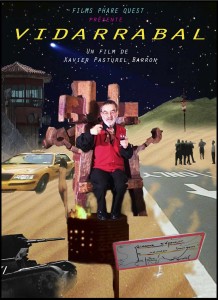
ARRABAL cineasta:
"Una de las obras cinematográficas más audaces, paroxísticas y artísticamente más acabadas" (Amos Vogel, ‘Village Voice’N.Y.);
‘Viva la muerte’ es una obra maestra absoluta . Una de las más deslumbrantes vistas en mi vida" (Pieyre de Mandiargues);
"Arrabal es ferozmente original" (John Parrack, ‘Rolling Stones’);
"Arrabal es mejor que Fellini, que Ingmar Bergman... es al cine lo que Rimbaud a la poesía. " (P. Bruckberger ‘Le Monde’).
-En 2007 el alcalde de París le otorgó el premio “Pasolini” de cine.
Mel Gussow (The New York Times) considera a Fernando Arrabal como el único superviviente de los « tres avatares de la modernidad»: surrealismo, pánico y patafísica. : Wikipedia
- Pasó tres años en el grupo surrealista (“es un pilar” dijo André Breton); pero no tuvo influencia bretoniana… : Arrabal ha repetido: “Malheureusement je suis arrivé trop tard au groupe; mon pli était pri; rien ne change dans mon œuvre”.
- Junto a Jodorowsky y Topor fundó el movimiento pánico.
Las siete películas, largo-metrajes dirigidas por Arrabal acaban de aparecer en DVD en Esp & Fr junto a 'Creaciones arrabalescas' de Christèle Jacob y 'F.A. cineasta pànico'. El pack figura en la colección "Initial Series (filmografía completa)" de Cameo Media S.L. y Wanda films.
cameo@cameo.es
wanda@wanda.es DiegoMoldesGonzalez@elcorteingles.es
Los siete largo-metrajes dirigidos por
FERNANDO ARRABAL (para todas sus películas Arrabal escribió también los guiones)son:
1970 Viva la muerte
coproduction Isabel-Films (Paris) et S.A.T.P.E.C. (Tunis), avec Nuria Espert, Ivan Henriques et Anouk Ferjac.
*
1972 J'irai comme un cheval fou
("Iré como un caballo loco") produit par la Société Générale de Production - Babylone Films, avec Emmanuelle Riva, Hachemi Marzouk et George Shannon.
*
1975 L'arbre de Guernica
("El àrbol de Guernica") produit par C.V.C. Communication, Federico Mueller et Harry N. Blum, avec Maria Angela Melato et Ron Faber.
*
1980 L'odyssée de la Pacific
("La odisea de la Pacifico" o "El emperador del Perù") produit par Babylone Films, avec Mickey Rooney et Monique Leclerc.
*
1981 Le cimetière des voitures
("El cementerio de automoviles") coproduction Antenne 2 et Babylone Films, avec Alain Bashung et Juliette Berto.
*
1992 Adieu, Babylone!
production Antenne 2 -Cinecim, avec Lélia Fischer et Spike Lee.
*
1998 Jorge Luis Borges
(Una vida de poesía) production Aphaville/Spirali (Italie), avec Lélia Fischer et Alessandro Atti.
dimanche
mardi
DVD 7 FILMS
Las siete películas de Arrabal acaban de aparecer en DVD en Esp & Fr +
+'Creaciones arrabalescas' de Christèle Jacob
y + 'F.A. cineasta pànico'
ccrusells@cameo.es
wanda@wanda.es
DiegoMoldesGonzalez@elcorteingles.es
+'Creaciones arrabalescas' de Christèle Jacob
y + 'F.A. cineasta pànico'
ccrusells@cameo.es
wanda@wanda.es
DiegoMoldesGonzalez@elcorteingles.es
vendredi
"Arrabal cinéaste panique" CULTE "Canal+ Ciné-Cinéma" France:

Fernando Arrabal, face caméra, revient sur la genèse de son cinéma magistral, initié en 1971 par son premier long-métrage choc VIVA LA MUERTE. Une oeuvre géniale marquée par des thèmes liés à l'enfance de l'artiste : la guerre d'Espagne, le franquisme, l'absence du père, la figure de la mère envahissante. Autant de sujets bouleversants qui jalonnent sa extraordinaire filmographie composée de sept films-culte parmi lesquels figurent LE CIMETIERE DES VOITURES (1983), première expérience cinématographique d'Alain Bashung, J'IRAI COMME UN CHEVAL FOU (1973), L'ARBRE DE GUERNICA (1985), L'EMPEREUR DU PEROU (1982)... Au rythme des extraits de films, le cinéaste et co-fondateur du mouvement Panique Alejandro Jodorowsky, Bernard-Henry Levy, Alain Bashung, le critique Henry Chapier, la comédienne Nuria Espert (interprète du personnage de la mère dans VIVA LA MUERTE), le réalisateur Jorge Armat décryptent l'univers singulier de ce " grand poète pur " et reviennent sur le tournage ou la sortie triomphale des films dans le monde.
"A SURREAL SHOCKER" - San Francisco Examiner.
"There are three perfect surrealist films: Un Chien Andalou, El Topo and Viva La Muerte."- digitalbits.com .
"INESCAPABLY A MAJOR WORK!"- N.Y. Times
Passages du long-métrage de Canal+, France 2008: "Arrabal cinéaste panique" :
"Canal+ Ciné-Cinéma Culte" France: 8-mars, 21h; 9-mars, 13h; 14-mars, 18h & 24h, etc
jeudi
"INESCAPABLY A MAJOR WORK!": NYTimes
The debut film of Spanish playwright Fernando Arrabal, VIVA LA MUERTE is a tour-de-force considered by many critics to be the pinnacle of Spanish avant-garde filmmaking. Fueled with surreal images of violence, sexuality and biting political commentary, the film posits Arrabal as the preeminent Spanish-language surrealists... "A SURREAL SHOCKER" - San Francisco Examiner. "There are three perfect surrealist films: Un Chien Andalou, El Topo and Viva La Muerte."- digitalbits.com . "INESCAPABLY A MAJOR WORK!"- N.Y. Times
mardi

Texte :
http://www.cultepics.com/
DVD Catalog # 036. RYKO distribution. 277 mins. New Digital Transfers. Three disc. + Interviews with Fernando Arrabal, Linner Notes on each film, Lobbycard, Trailers, Fernando Arrabal in Hollywood.
http://www.cultepics.com/
DVD Catalog # 036. RYKO distribution. 277 mins. New Digital Transfers. Three disc. + Interviews with Fernando Arrabal, Linner Notes on each film, Lobbycard, Trailers, Fernando Arrabal in Hollywood.
...intensity and a complex vitality that I have not seen equalled in recent cinema... : NYTimes
Siete largo-metrajes dirigidos por
FERNANDO ARRABAL
(Para todas sus películas Arrabal escribió también los guiones).
1970 Viva la muerte
coproduction Isabel-Films (Paris) et S.A.T.P.E.C. (Tunis), avec Nuria Espert, Ivan Henriques et Anouk Ferjac.
*
1972 J'irai comme un cheval fou
("Iré como un caballo loco") produit par la Société Générale de Production - Babylone Films, avec Emmanuelle Riva, Hachemi Marzouk et George Shannon.
*
1975 L'arbre de Guernica
("El àrbol de Guernica") produit par C.V.C. Communication, Federico Mueller et Harry N. Blum, avec Maria Angela Melato et Ron Faber.
*
1980 L'odyssée de la Pacific
("La odisea de la Pacifico" o "El emperador del Perù") produit par Babylone Films, avec Mickey Rooney et Monique Leclerc.
*
1981 Le cimetière des voitures
("El cementerio de automoviles") coproduction Antenne 2 et Babylone Films, avec Alain Bashung et Juliette Berto.
*
1992 Adieu, Babylone!
production Antenne 2 -Cinecim, avec Lélia Fischer et Spike Lee.
*
1998 Jorge Luis Borges
(Una vida de poesía) production Aphaville/Spirali (Italie), avec Lélia Fischer et Alessandro Atti.
____________________________________
Tres corto-metrajes:
Sang et or
("Sangre y oro") 1978.
Une production "Antenne 2" avec Edgar Rock et Josua Watsky.
Echecs et Mythe
("Jaque y mito") 1990 .
Une production "Antenne 2" avec Joël Laitier, Roland Topor, July Delpy et Gabriel Matzneff.
New York, New York!
(La guerra del Golfo) 1991 .
Une production "Antenne 2" avec Tom O'Horgan, Melvin Van Peebles et Tom Bishop.
_____________________________________
Varios films adaptados de la obra de
Fernando Arrabal:
Le Grand Cérémonial (dir. Pierre-Alain Jolivet),
El triciclo (dir. Luis Argueta),
El ladrón de sueños (dir. Arroyo),
Pique-nique (dir. Louis Sénechal),
Guernica (dir. Peter Lilienthal)
Fando et Lis (dir. Alejandro Jodorowsky), etc.
_________________________________________________________________________________
New York Times Review Movie Review
Screen: Arrabal's 'Viva la Muerte'By ROGER GREENSPUN
Having seen and disliked Alexandro Jodorowsky's screen adaptation of an early Arrabal play, "Fando and Lis," and having duly noted the symbols of horror, the rituals of disgust, the obligatory and unfelt eroticism, and the pervasive allegory, I was in no way prepared for Fornando Arrabal's own first film, "Viva la Muerte," in which those elements reappear—but charged now with an intensity and a complex vitality that I have not seen equalled in recent cinema, . "Viva la Muerte" ("Long Live Death") has begun a series of midnight screenings at the St. Marks Cinema and, though no perfect movie, it seems to me inescapably a major work.
Its hero (Mahdi Chaóuch), a young boy, is also named Fando, and its story closely parallels the early life history of Fernando Arrabal, whose mother betrayed her leftist husband to the Fascists during the Spanish civil war—and who taught her son that his father was dead, whereas in fact he was miserably imprisoned. Fando searches for his father and never finds him, as Arrabal never found his, but he remembers him and imagines his fate—and in a series of harsh monochrome fantasy passages, memory and imagination largely define the unique life of the film.
The imagery of "Viva la Muerte"—the defecation, self-mortification, strange and unusual punishment—reads like an illustrative footnote to some Surrealist manifesto. It is as if the famous razor across the eyeball that opens Bunuel's "Un Chien Andalou" had never lost its cutting edge, its sharp capacity to peel back fair surfaces and reveal the soft sources of corruption underneath. As an esthetic program this has its limits, but within those limits it allows for insights not only of hard brilliance but also of a sometimes shockingly compassionate humanity.
The enemy in "Viva la Muerte" seems not so much the Fascist state or its police, as the women who fear it and collaborate with it: the mother, an aunt, a grandmother, all in black, like ministers of death, and yet in mourning for the suffering caused by their own ministry. The mourning is genuine, as is the cruelty—and it is Arrabal's great distinction not to undercut the one by the other, but rather to hold each in balance so that no contradictory impulse is lost on us. He is fortunate in having as the mother Nuria Espert, an actress of striking beauty, strong and graceful gestures and an emotional range that takes her from near frenzy to a languid sensuality without ever losing contact with a role that might seem to comprise half a dozen different characters.
Near the end of "Viva la Muerte" it is discovered that Fando has tuberculosis (as Arrabal bad), and he is taken to a hospital ship and eventually operated on. From his recovery room he is abducted by a mysterious little girl, also in black, who keeps a pet turkey and whom he has known and casually tormented all through the film. A captive now of his own sweet bitter fate he is wheeled off into a part of the gorgeous arid landscape that is the film's locale. And by, and girl, and great improbable bird enter a configuration that outlasts the generations and is not explained but is somehow understood as an emblem of unending torture and delight.
The Cast
VIVA LA MUERTE, directed by Fernando Arrabal; screenplay (French with English subtitles) by Mr. Arrabal; photographed by Jean-Marc Ripert; music by Jean-Yves Bosseur; produced by Jacques Pollreneaud; released by Max L. Raab in association with Paul Bartel and Elinor Silverman. Midnights, at the St. Marks Cinema, Second Avenue and St. Marks Place. Running time: 90 minutes. (Not submitted at this time to the Motion Picture Association of America's Production Codeand Rating Administration for rating as to audience suitability.
The Aunt . . . . . Anouk Ferjac
The Mother . . . . . Nuria Espert
The Father . . . . . Ivan Henriques
The Boy . . . . . Mahdi Chaouch
The Girl . . . . . Jazia Kilbi
FERNANDO ARRABAL
(Para todas sus películas Arrabal escribió también los guiones).
1970 Viva la muerte
coproduction Isabel-Films (Paris) et S.A.T.P.E.C. (Tunis), avec Nuria Espert, Ivan Henriques et Anouk Ferjac.
*
1972 J'irai comme un cheval fou
("Iré como un caballo loco") produit par la Société Générale de Production - Babylone Films, avec Emmanuelle Riva, Hachemi Marzouk et George Shannon.
*
1975 L'arbre de Guernica
("El àrbol de Guernica") produit par C.V.C. Communication, Federico Mueller et Harry N. Blum, avec Maria Angela Melato et Ron Faber.
*
1980 L'odyssée de la Pacific
("La odisea de la Pacifico" o "El emperador del Perù") produit par Babylone Films, avec Mickey Rooney et Monique Leclerc.
*
1981 Le cimetière des voitures
("El cementerio de automoviles") coproduction Antenne 2 et Babylone Films, avec Alain Bashung et Juliette Berto.
*
1992 Adieu, Babylone!
production Antenne 2 -Cinecim, avec Lélia Fischer et Spike Lee.
*
1998 Jorge Luis Borges
(Una vida de poesía) production Aphaville/Spirali (Italie), avec Lélia Fischer et Alessandro Atti.
____________________________________
Tres corto-metrajes:
Sang et or
("Sangre y oro") 1978.
Une production "Antenne 2" avec Edgar Rock et Josua Watsky.
Echecs et Mythe
("Jaque y mito") 1990 .
Une production "Antenne 2" avec Joël Laitier, Roland Topor, July Delpy et Gabriel Matzneff.
New York, New York!
(La guerra del Golfo) 1991 .
Une production "Antenne 2" avec Tom O'Horgan, Melvin Van Peebles et Tom Bishop.
_____________________________________
Varios films adaptados de la obra de
Fernando Arrabal:
Le Grand Cérémonial (dir. Pierre-Alain Jolivet),
El triciclo (dir. Luis Argueta),
El ladrón de sueños (dir. Arroyo),
Pique-nique (dir. Louis Sénechal),
Guernica (dir. Peter Lilienthal)
Fando et Lis (dir. Alejandro Jodorowsky), etc.
_________________________________________________________________________________
New York Times Review Movie Review
Screen: Arrabal's 'Viva la Muerte'By ROGER GREENSPUN
Having seen and disliked Alexandro Jodorowsky's screen adaptation of an early Arrabal play, "Fando and Lis," and having duly noted the symbols of horror, the rituals of disgust, the obligatory and unfelt eroticism, and the pervasive allegory, I was in no way prepared for Fornando Arrabal's own first film, "Viva la Muerte," in which those elements reappear—but charged now with an intensity and a complex vitality that I have not seen equalled in recent cinema, . "Viva la Muerte" ("Long Live Death") has begun a series of midnight screenings at the St. Marks Cinema and, though no perfect movie, it seems to me inescapably a major work.
Its hero (Mahdi Chaóuch), a young boy, is also named Fando, and its story closely parallels the early life history of Fernando Arrabal, whose mother betrayed her leftist husband to the Fascists during the Spanish civil war—and who taught her son that his father was dead, whereas in fact he was miserably imprisoned. Fando searches for his father and never finds him, as Arrabal never found his, but he remembers him and imagines his fate—and in a series of harsh monochrome fantasy passages, memory and imagination largely define the unique life of the film.
The imagery of "Viva la Muerte"—the defecation, self-mortification, strange and unusual punishment—reads like an illustrative footnote to some Surrealist manifesto. It is as if the famous razor across the eyeball that opens Bunuel's "Un Chien Andalou" had never lost its cutting edge, its sharp capacity to peel back fair surfaces and reveal the soft sources of corruption underneath. As an esthetic program this has its limits, but within those limits it allows for insights not only of hard brilliance but also of a sometimes shockingly compassionate humanity.
The enemy in "Viva la Muerte" seems not so much the Fascist state or its police, as the women who fear it and collaborate with it: the mother, an aunt, a grandmother, all in black, like ministers of death, and yet in mourning for the suffering caused by their own ministry. The mourning is genuine, as is the cruelty—and it is Arrabal's great distinction not to undercut the one by the other, but rather to hold each in balance so that no contradictory impulse is lost on us. He is fortunate in having as the mother Nuria Espert, an actress of striking beauty, strong and graceful gestures and an emotional range that takes her from near frenzy to a languid sensuality without ever losing contact with a role that might seem to comprise half a dozen different characters.
Near the end of "Viva la Muerte" it is discovered that Fando has tuberculosis (as Arrabal bad), and he is taken to a hospital ship and eventually operated on. From his recovery room he is abducted by a mysterious little girl, also in black, who keeps a pet turkey and whom he has known and casually tormented all through the film. A captive now of his own sweet bitter fate he is wheeled off into a part of the gorgeous arid landscape that is the film's locale. And by, and girl, and great improbable bird enter a configuration that outlasts the generations and is not explained but is somehow understood as an emblem of unending torture and delight.
The Cast
VIVA LA MUERTE, directed by Fernando Arrabal; screenplay (French with English subtitles) by Mr. Arrabal; photographed by Jean-Marc Ripert; music by Jean-Yves Bosseur; produced by Jacques Pollreneaud; released by Max L. Raab in association with Paul Bartel and Elinor Silverman. Midnights, at the St. Marks Cinema, Second Avenue and St. Marks Place. Running time: 90 minutes. (Not submitted at this time to the Motion Picture Association of America's Production Codeand Rating Administration for rating as to audience suitability.
The Aunt . . . . . Anouk Ferjac
The Mother . . . . . Nuria Espert
The Father . . . . . Ivan Henriques
The Boy . . . . . Mahdi Chaouch
The Girl . . . . . Jazia Kilbi
Inscription à :
Messages (Atom)